Alina
Alina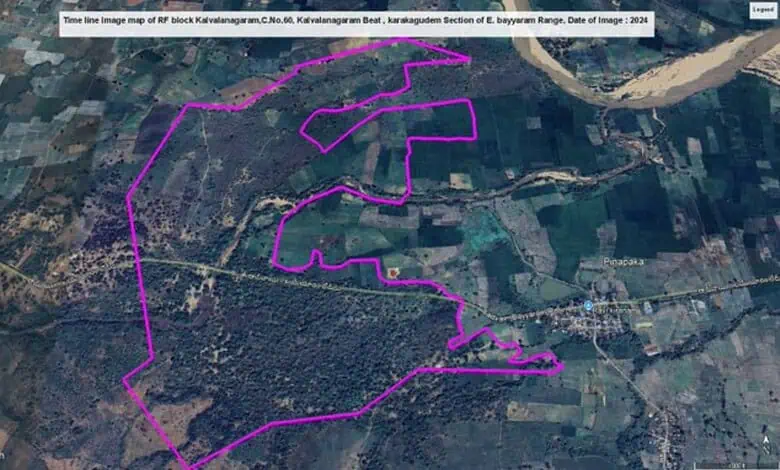
Supreme Court Safeguards Telangana Forest
Supreme Court Protects Telangana Forest Land
In a significant and long-awaited ruling, the Supreme Court of India has brought closure to a legal battle that stretched across more than seven decades. The apex court dismissed claims made by private individuals over nearly 600 acres of forest land located in Telangana, thereby preserving the ecological integrity of the region and reinforcing legal principles governing land ownership.
The dispute revolved around Survey No. 81 in Kalvalanagaram village, situated in the Karakagudem mandal of Bhadradri Kothagudem district. This area, historically documented as forest land, became the subject of competing claims rooted in alleged land grants dating back to the pre-independence era.
Background of the Long-Standing Dispute
The appellants, including Vadiyala Prabhakar Rao and others, asserted that their claim to the land originated from pattas allegedly granted during the rule of Mir Osman Ali Khan, the Seventh Nizam of Hyderabad. According to their argument, rights were initially created around 1920 (1330 Fasli) in favor of certain individuals known as Sivai Jamandars, which were later formalized through pattas issued in the early 1930s.
These claims suggested that the land had been legally transferred to their predecessors and subsequently inherited or passed down to them. However, the absence of original documentation became a critical weakness in their case.
Meanwhile, in 1950, a proposal was initiated to notify approximately 787 acres in the same survey number as forest land. This included the disputed 600 acres, which the state later treated as part of its protected forest area.
Initial Legal Proceedings and Findings
The matter first underwent scrutiny at the administrative level when the Joint Collector of the erstwhile Khammam district examined the claims in 2003. After reviewing the evidence presented, the authority rejected the claimants’ assertions due to a lack of credible documentation.
One of the most significant observations was that the claimants failed to produce original patta certificates—documents that are essential for establishing ownership. Instead, they relied heavily on revenue records, which, according to legal principles, do not constitute proof of ownership.
Additionally, it was found that the claimants had not been in physical possession of the land for nearly 70 years. The land remained uncultivated and was covered with dense forest growth, further weakening their claim of ownership or usage.
Another key issue was the lack of clarity regarding the transfer of ownership from the original twelve alleged pattadars to the two primary claimants. Without proper documentation explaining this transition, the claim appeared inconsistent and unsupported.
Conflicting Judgements in High Court
The case then moved to the Andhra Pradesh High Court, where a single bench initially ruled in favor of the claimants in 2012. The bench accepted their argument that pattas had indeed been granted in 1933 and noted that certain records might have been destroyed during Operation Polo.
The single judge also relied on reports from revenue officials, which suggested that the original pattadars had paid for forest growth valuation and obtained permissions from authorities.
However, this decision did not stand unchallenged. A division bench of the High Court later overturned the single bench ruling. It emphasized that revenue entries must be backed by valid documentation submitted during mutation processes. In the absence of such documents, the entries lacked legal sanctity.
The division bench also clarified that a notification would not become invalid merely because it was issued under a repealed law, as long as it was consistent with the provisions of the current legislation.
Arguments Presented Before the Supreme Court
When the matter reached the Supreme Court of India, the appellants attempted to strengthen their case by presenting multiple revenue records, including Faisal Patti, Pahanis, and Vasool Baqi documents from different Fasli years.
Despite this, the Court remained unconvinced. It clearly stated that revenue records, by themselves, do not create ownership rights. The foundation of any ownership claim must be a valid title document, such as a patta certificate, which the appellants failed to provide.
The bench, comprising Justice SVN Bhatti and Justice Pankaj Mittal, also noted that the appellants appeared to be prolonging the legal process without substantive grounds, especially when their claims had already been weakened by lack of evidence.
Key Observations by the Apex Court
The Supreme Court made several critical observations that hold importance not just for this case but for land disputes across the country:
- Revenue records cannot be treated as definitive proof of ownership.
- Payment of taxes or obtaining loans based on such records does not establish legal title.
- Revenue records can sometimes be manipulated, and therefore must be supported by authentic title documents.
- Fabricated or manipulated records cannot override the rights of the state or actual landholders.
The Court also pointed out that such practices can be used as a “camouflage” to illegally claim land, and the government is not bound to accept such records.
Historical Records Confirm Forest Status
One of the decisive factors in the case was the Pahani record of Kalvalanagaram village for the Fasli years 1346 to 1356. These records clearly categorized Survey No. 81 as “Jungle/Forest” land.
This classification reinforced the state’s position that the land had always been recognized as forest area and was never legitimately transferred into private ownership.
Final Verdict and Its Impact
After evaluating all aspects of the case, the Supreme Court dismissed the civil appeal filed by the claimants. This verdict effectively ended a prolonged legal dispute and reaffirmed the status of the land as protected forest.
The ruling is significant for several reasons:
- It strengthens legal safeguards against illegal land claims.
- It reinforces the importance of proper documentation in property disputes.
- It protects environmentally sensitive areas from encroachment.
- It sets a precedent for similar cases across India.
Environmental and Legal Significance
Beyond the legal implications, the judgement carries substantial environmental importance. Forest lands play a crucial role in maintaining ecological balance, supporting biodiversity, and combating climate change.
By preventing the conversion of forest land into private property, the court has contributed to conservation efforts and sustainable land use practices.
Conclusion
The Supreme Court’s decision in this case highlights the importance of evidence-based legal processes and the need to protect public resources from unlawful claims. It sends a strong message that historical claims must be backed by credible documentation and that revenue records alone cannot establish ownership.
As land disputes continue to emerge across India, this ruling serves as a guiding framework for courts, governments, and individuals alike. Most importantly, it ensures that vital forest resources remain protected for future generations.