

India Russia China US relations
Trump Says India and Russia Moving Closer to China: A Deep Dive into Shifting Global Alliances
Introduction
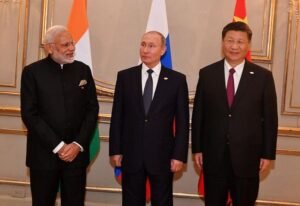
US President Donald Trump has once again stirred global attention with his comments on the evolving dynamics between India, Russia, and China. In a recent statement, Trump suggested that the United States has “lost” India and Russia to the “darkest” China, as the three major powers continue to display camaraderie on international platforms. His remarks came shortly after a Shanghai Cooperation Organisation (SCO) summit in Tianjin, China, where Prime Minister Narendra Modi, Russian President Vladimir Putin, and Chinese President Xi Jinping were seen showcasing unity.
This development raises important questions about the future of India-US relations, the balance of power in Asia, and the growing convergence between New Delhi, Moscow, and Beijing.
The Viral Video from SCO Summit
The SCO summit in Tianjin not only focused on strengthening security and economic cooperation but also became the backdrop for a viral video that caught the attention of global audiences. The clip showed Prime Minister Modi and President Putin walking hand in hand towards Xi Jinping, with all three leaders later forming a close circle, symbolizing strong friendship.
For Trump, this visual was symbolic of the US losing ground in Asia’s geopolitical landscape. He took to his platform, Truth Social, to write:
“Looks like we have lost India and Russia to deepest, darkest China. May they have a long and prosperous future together!”
US-India Relations: A Strained Phase
Trump’s comments come at a time when India-US relations are facing one of their most difficult periods in more than two decades. The friction primarily stems from trade disagreements and Washington’s displeasure over New Delhi’s growing energy ties with Moscow.
The Trump administration recently imposed additional tariffs on Indian goods, doubling duties to 50 percent. These tariffs were also linked to India’s continued purchase of Russian crude oil despite Western sanctions. India responded sharply, describing the US action as “unfair, unjustified, and unreasonable”, questioning why it was being singled out while China, the world’s largest importer of Russian crude, faced no such penalties.
Tariffs and Trade Tensions
The imposition of punitive tariffs has been a major sore point. Trump’s government justified the move by accusing India of acting as a “refining hub and oil money laundromat” for Russian crude. White House trade advisor Peter Navarro went so far as to say that India’s energy policies were indirectly strengthening the Kremlin.
This aggressive rhetoric has worsened tensions, undermining years of bilateral cooperation in areas like defense, technology, and education. The collapse of trade deal negotiations added to the strain, despite multiple rounds of talks between officials of both countries.
India’s Energy Strategy and Russia’s Role
India, however, has defended its purchase of discounted Russian oil, stating that its energy security is guided by national interest and market dynamics. Following the Russia-Ukraine conflict in 2022 and subsequent Western sanctions on Moscow, India turned to Russian supplies, which were offered at competitive rates.
The numbers tell the story:
-
In 2019–20, Russian crude accounted for only 1.7% of India’s oil imports.
-
By 2024–25, that share had skyrocketed to 35.1%, making Russia India’s largest supplier.
For a growing economy like India’s, where energy demand continues to rise, such decisions are framed as practical rather than political.
China’s Expanding Influence
Meanwhile, China continues to expand its geopolitical influence through initiatives like the Belt and Road and closer defense cooperation with Russia. President Xi Jinping’s vision for a new global security and economic order was a key theme of the SCO summit. His call for prioritizing the Global South resonated with several nations, including India and Russia, both of which have sought to diversify their international partnerships.
Trump interpreted this emerging unity as a direct challenge to US influence, especially as China hosted several global leaders at its Victory Day parade.

Trump’s Strong Remarks
Not holding back, Trump accused Xi Jinping of “conspiring” with Putin and North Korea’s Kim Jong Un against the United States. He even sarcastically extended “warm regards” to the three leaders, underscoring his view that the US was being sidelined on the global stage.
His words signal a broader concern within Washington’s strategic community—that India, once seen as a natural ally of the US against China, is now showing signs of leaning closer to Beijing and Moscow.
Historical Context of India-US Relations
India and the US have had a roller-coaster relationship over the decades. While the Cold War era was marked by mistrust due to India’s closeness with the Soviet Union, ties improved dramatically in the 21st century. Key milestones such as the 2005 US-India Civil Nuclear Agreement and deepening defense cooperation laid the foundation for stronger relations.
In recent years, India was seen as a crucial partner in Washington’s Indo-Pacific strategy aimed at countering China’s rise. However, the latest developments hint at possible cracks in this framework.
The SCO Factor and Asian Power Dynamics
The Shanghai Cooperation Organisation has increasingly become a stage for Asian powers to assert their strategic independence. With India, Russia, and China as prominent members, the platform provides opportunities for dialogue outside Western-dominated forums like the G7.
The visible warmth between Modi, Putin, and Xi at the summit not only underscored their common interests but also highlighted the limitations of US influence in shaping global coalitions.
Trade Deal Negotiations Collapse
India and the US had been negotiating a bilateral trade deal for months, but sharp differences in areas like agriculture, dairy, and intellectual property prevented an agreement. The collapse of talks further deepened mistrust, with Trump repeatedly claiming credit for resolving the India-Pakistan border conflict—an assertion India rejected.
With bilateral trade standing at around USD 130 billion in 2023, the potential for growth remains high. However, unless political will is restored on both sides, future prospects could remain uncertain.
Possible Global Implications
The growing proximity between India, Russia, and China could reshape international politics in several ways:
-
Energy and Economic Ties – India and China both rely heavily on Russian crude, making Moscow a vital partner.
-
Security and Defense Cooperation – Shared concerns about Western influence could push the three nations to collaborate more closely on defense.
-
Challenge to US Dominance – A potential “Eurasian bloc” of India, Russia, and China could counterbalance Western-led alliances.
Conclusion
Donald Trump’s latest remarks reflect more than just political rhetoric—they underline a significant shift in global geopolitics. India’s balancing act between the US and Russia-China is becoming increasingly difficult, especially as Washington pushes punitive measures while Beijing and Moscow offer economic and energy incentives.
Whether this is a temporary strain or the beginning of a long-term realignment remains to be seen. What is clear, however, is that the India-Russia-China axis is gaining visibility, and the United States will have to rethink its strategy if it wants to keep New Delhi closer to its fold.