
Stalin Joins Bihar Voter Adhikar Yatra
Introduction
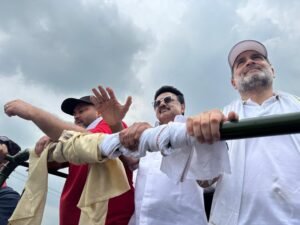
Indian politics is witnessing high-octane activity as the Congress-led ‘Voter Adhikar Yatra’ continues to gain momentum across Bihar. The yatra, spearheaded by senior opposition leaders including Rahul Gandhi, Priyanka Gandhi Vadra, and RJD leader Tejashwi Yadav, saw a significant boost when Tamil Nadu Chief Minister M. K. Stalin and his sister, DMK MP Kanimozhi, joined the rally in Muzaffarpur on August 27.
The political march, aimed at raising awareness about electoral rights and alleged irregularities in the democratic process, has not only attracted mass participation but also triggered sharp political exchanges between opposition parties and the BJP. Stalin’s arrival in Bihar coincides with mounting criticism from the Tamil Nadu BJP, which accused the DMK leadership of making “anti-Bihar” and “anti-Sanatana Dharma” statements.
This development marks an important intersection of regional politics and national narratives, setting the stage for deeper collaboration among opposition forces ahead of upcoming electoral battles.
The Yatra and its Symbolism
The Voter Adhikar Yatra is not just another political rally. Launched on August 17 from Sasaram, the 1,300-kilometer journey is set to culminate in Patna on September 1 with a massive rally. Its primary objective is to highlight alleged issues of voter suppression, electoral malpractice, and the weakening of democratic institutions.
The yatra has been carefully designed to symbolize unity among opposition forces, drawing leaders from different states and ideological backgrounds. When Stalin, a prominent southern leader, joined hands with Rahul Gandhi, Tejashwi Yadav, and Priyanka Gandhi, the message was loud and clear: the opposition is building a pan-India coalition.
Stalin’s Address and Social Media Post
Upon reaching Bihar, Stalin shared a message on social media platform X (formerly Twitter). He wrote:
“Touchdown Bihar…the land of respected Lalu Prasad Ji greets me with fire in its eyes, the soil heavy with every stolen vote. Joined by my brothers Rahul Gandhi Jee, Tejashwi Yadav and sister Priyanka Gandhi Vadra as the ‘Voter Adhikar Yatra’ turns people’s pain into unstoppable strength.”
His words not only paid homage to veteran leader Lalu Prasad Yadav but also underlined the emotional undertone of the campaign — connecting people’s anger over perceived electoral injustices with a collective movement for change.
Bikes, Streets, and Symbolic Gestures
Earlier in the day, the yatra witnessed a highly symbolic moment. Rahul Gandhi and Tejashwi Yadav rode motorcycles through the streets of Muzaffarpur, cheered on by crowds lining both sides of the road. Priyanka Gandhi Vadra was seen riding pillion on Rahul’s bike, creating striking visuals that quickly went viral.
The motorcycle ride served as a metaphor for grassroots connect, projecting the leaders as approachable, energetic, and in sync with the youth of Bihar. It was also a symbolic throwback to the Congress’s attempts at mass mobilization during earlier political campaigns.

Tamil Nadu BJP’s Counterattack
Even as Stalin extended solidarity with the Congress in Bihar, the Tamil Nadu BJP launched a scathing counteroffensive. K. Annamalai, BJP leader and former state president, released what he described as a compilation of remarks made by DMK leaders that were allegedly insulting towards the people of Bihar and disrespectful of Sanatana Dharma.
Annamalai questioned Stalin’s political integrity and dared him to repeat such controversial statements in front of the people of Bihar while sharing the stage with Rahul Gandhi.
The Controversial Remarks
The BJP’s criticism stems from past remarks made by DMK leaders, including:
-
Udhayanidhi Stalin’s Sanatana Dharma remark (2023): The Tamil Nadu minister compared Sanatan Dharma to diseases like dengue and malaria, saying it must be “eradicated” rather than opposed. His words triggered nationwide outrage, particularly among right-wing groups, leading to legal petitions. However, the Supreme Court in January 2024 refused to entertain pleas for registering an FIR against him.
-
Dayanidhi Maran’s comment on Biharis: Maran was accused of making disparaging remarks about Bihari migrant workers in Tamil Nadu, suggesting they were relegated to menial jobs.
-
Other DMK leaders’ statements: Senior figures such as TRB Rajaa, KN Nehru, K. Ponmudy, RS Bharathi, and VCK chief Thol Thirumavalavan have also faced criticism for their alleged derogatory references to Biharis and Hindu traditions.
Annamalai’s compilation sought to consolidate these incidents into a political weapon, timed to coincide with Stalin’s Bihar visit.
Annamalai’s Challenge
In a strongly worded online statement, Annamalai said:
“TN CM Thiru @mkstalin avl is in Bihar today. Here is an evergreen compilation of his, his party members’, and his alliance partners’ uncouth remarks about our Bihari brothers and sisters. Hope he takes the stage with Thiru @RahulGandhi avl and proudly repeats every one of those insults in front of the very people he and his party members mocked.”
The BJP leader further asked Stalin if he had the courage to repeat Udhayanidhi Stalin’s words on Sanatana Dharma or Maran’s remarks on Bihari workers while addressing the Bihar rally.
Political Fallout
The clash between Stalin’s symbolic participation in the yatra and BJP’s counterattack highlights the deepening polarization in Indian politics.
For the Congress and its allies, Stalin’s presence strengthens the ‘INDIA bloc’, projecting a united opposition front. It helps them bridge the North-South divide and shows that regional satraps are willing to join hands with national parties against the BJP.
For the BJP, however, raising past controversies serves as an effective strategy to question the credibility of opposition leaders. By highlighting alleged “anti-Bihar” comments, the party hopes to undercut the resonance of the yatra in Bihar, a state with immense electoral significance.
Historical and Political Context
Bihar has long been a battleground for competing political ideologies. The state has produced towering leaders like Jayaprakash Narayan, Lalu Prasad Yadav, and Nitish Kumar. Today, it remains a key arena for both BJP and opposition forces.
Tamil Nadu, on the other hand, is historically dominated by Dravidian parties like DMK and AIADMK. Stalin’s participation in a Bihar rally reflects his willingness to expand DMK’s political narrative beyond Tamil Nadu and align with pan-India opposition strategies.
Public Response
Crowds in Muzaffarpur greeted the leaders with enthusiasm, waving flags, chanting slogans, and lining the roads to catch a glimpse of the rally. While the BJP’s criticisms have sparked debates online, on the ground the yatra continues to enjoy support among sections of the populace who feel marginalized or unheard in the current political climate.
Conclusion
The Voter Adhikar Yatra is shaping up to be more than a symbolic exercise; it is a stage for political alliances, rhetorical battles, and mass mobilization. Stalin’s participation has amplified its significance, linking Tamil Nadu’s Dravidian politics with Bihar’s electoral struggles.
At the same time, the BJP’s aggressive counter-narrative underscores that the road to 2024 elections will be marked by intense scrutiny of leaders’ past statements and actions. Whether the opposition can translate symbolic unity into electoral gains remains to be seen.