
Uttarakhand cloudburst rescue operations
Uttarakhand Disaster Leaves Six Dead and Eleven Missing
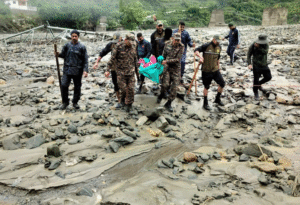
The northern Himalayan state of Uttarakhand has once again been hit hard by nature’s fury. Torrential rains and cloudbursts across multiple districts, including Rudraprayag, Chamoli, Bageshwar, and Tehri, have left six people dead and eleven missing. Rescuers have been digging through knee-high debris in the worst-hit Chenagad area of Rudraprayag, where homes, shops, and roads were swept away by powerful water currents.
The incident, which occurred on Friday following heavy downpours, is the latest in a series of natural disasters that have battered Uttarakhand this monsoon. While rescue operations have intensified with the weather clearing on Saturday, officials warn that the scale of destruction is massive and full recovery will take time.

The Human Toll of the Disaster
According to reports from district administrations, six lives have been lost so far. Among the missing are eleven people, including four locals and four Nepali laborers from the Chenagad region, along with three others from Bageshwar.
The tragedy has not only claimed human lives but also left villages disconnected from essential services. Markets have been destroyed, roads breached, and electricity lines snapped, throwing thousands into darkness and despair.
Rescue Efforts Intensify Amidst Debris
Rescue teams, including personnel from the National Disaster Response Force (NDRF), State Disaster Response Force (SDRF), and local police, have been working tirelessly to locate survivors.
“More than ten shops and roadside eateries in Chenagad market have been completely washed away. Our immediate focus is to restore road access so that heavy machines can be brought in to remove the rubble,” said Prateek Jain, District Magistrate of Rudraprayag.
Currently, operations are slowed by the lack of heavy machinery. Manual digging through knee-deep debris makes it extremely difficult to reach those still trapped. Authorities admit that every hour lost reduces the chances of finding survivors alive.
Widespread Destruction Across Districts
The devastation was not limited to Rudraprayag. In Chamoli, Bageshwar, and Tehri, landslides and flash floods swept through villages, damaging homes and infrastructure.
-
Chamoli & Rudraprayag: Reported five deaths on Friday.
-
Dehradun: A 10-year-old boy’s body was recovered from a river.
-
Bageshwar: Three persons remain missing.
The Chenagad belt remains the epicenter of destruction, where communication and transport links are severely disrupted.
A State Familiar with Disasters
Uttarakhand’s fragile Himalayan terrain makes it particularly vulnerable to monsoon-related disasters. The state frequently experiences cloudbursts, flash floods, and landslides, especially between July and September.
In fact, the August 30 tragedy came just days after earlier disasters:
-
August 23: At Tharali in Chamoli, a woman was killed and another went missing after heavy rains.
-
August 5: A flash flood in the Kheer Ganga river ravaged Dharali in Uttarkashi, sweeping away hotels and homestays along the Gangotri route. Even an army camp in Harsil was affected, leaving residents no time to escape.
According to the Uttarakhand State Disaster Management Authority (USDMA), since April this year, 74 people have died, 107 injured, and 95 remain missing in disasters triggered by heavy rains.
Chief Minister Pushkar Singh Dhami’s Response
Chief Minister Pushkar Singh Dhami conducted a review of relief and rescue efforts. Stressing on vigilance, he directed district officials to remain on alert mode in all disaster-prone areas.
“Natural disasters cannot be controlled, but our response can. Relief and rescue teams are doing commendable work by reaching affected zones immediately and saving lives,” Dhami stated.
He has instructed disaster management authorities to prioritize precautionary measures in sensitive regions and ensure that people living in vulnerable zones are given adequate protection.
Relief Measures for Affected Families
Despite the scale of destruction, the administration has been proactive in delivering relief materials to stranded families. In Tal Jaman village, authorities distributed:
-
25 food packets
-
5,000 bottles of water
-
5,000 salty snack packets
-
250 ration kits
Additionally, due to power outages in Tal Jaman and Dungar villages, the Uttarakhand Renewable Energy Development Agency (UREDA) supplied 15 solar lights in Tal Jaman and 10 in Dungar as a temporary measure until electricity lines are restored.
Impact on Livestock and Veterinary Assistance
The disaster has also affected livestock, which are a primary livelihood source for many villagers.
Chief Veterinary Officer Ashish Rawat revealed that 15 animals are missing, including three bulls, eight cows, three buffaloes, and a calf. Two animals were rescued from debris, while first aid was administered to 15 injured animals.
The Veterinary Department has deployed an 11-member expert team to different villages for animal care, ensuring that rural households dependent on cattle are not left unsupported.
Chenagad: The Worst-Hit Region
Officials confirmed that Chenagad in Rudraprayag bore the brunt of Friday’s cloudburst. Prem Singh Rawat, the district nodal officer, reported that rescue teams are continuously trying to trace the missing.
Rawat also inspected schools, houses, and cattle shelters to assess damage. Many educational buildings have suffered cracks, making them unsafe for children. Temporary shelters are now being considered for displaced families.
Electricity and Road Connectivity Challenges
The disruption of power supply has compounded the misery of affected families. Villages have been plunged into darkness, with communication networks breaking down. The Electricity Department has assured that restoration work is underway.
Meanwhile, road connectivity remains a critical bottleneck. Many stretches have caved in or been blocked by landslides, preventing the movement of relief convoys and machinery. Restoring these roads has become the top priority of the administration.
Community Resilience and Volunteer Support
Local volunteers, NGOs, and community groups have joined forces with official rescue teams. They are assisting in distributing food, clearing debris, and providing psychological comfort to families who have lost everything.
Despite the destruction, stories of resilience continue to emerge. Villagers have been seen sharing limited resources, organizing makeshift shelters, and supporting elderly neighbors through the crisis.
Recurring Natural Disasters Raise Questions
The repeated disasters this monsoon have reignited debates over Uttarakhand’s development model and disaster preparedness. Experts point to unregulated construction, deforestation, and encroachment on riverbanks as reasons why cloudbursts cause such extensive destruction.
Environmentalists argue that while relief efforts are commendable, long-term mitigation strategies must include stricter building regulations, improved early-warning systems, and reforestation drives to stabilize fragile mountain slopes.
Looking Ahead: The Road to Recovery
The Uttarakhand government has pledged to prioritize rehabilitation and rebuilding in disaster-affected areas. This includes restoring schools, repairing power grids, compensating affected families, and supporting farmers who lost crops and livestock.
District Magistrate Prateek Jain assured that relief and rehabilitation would be taken up on “top priority”, with all possible assistance provided to displaced families.
However, experts caution that recovery will take time and sustained effort, given the frequency of monsoon-related disasters in the state.
Conclusion
The Uttarakhand cloudburst and flooding tragedy of August 30 serves as another stark reminder of the fragile ecological balance in the Himalayas. With six confirmed deaths, eleven missing, and widespread destruction of homes, roads, and livestock, the state faces yet another challenge in its long history of natural calamities.
While rescue operations are in full swing and relief packages are being distributed, the bigger question remains—how can Uttarakhand balance its developmental needs with ecological preservation to minimize the scale of such disasters in the future?
For now, the focus remains on saving lives, restoring infrastructure, and providing immediate relief to those caught in the devastation. The resilience of Uttarakhand’s people, combined with government and community efforts, will be crucial in overcoming this crisis.