Alina
Alina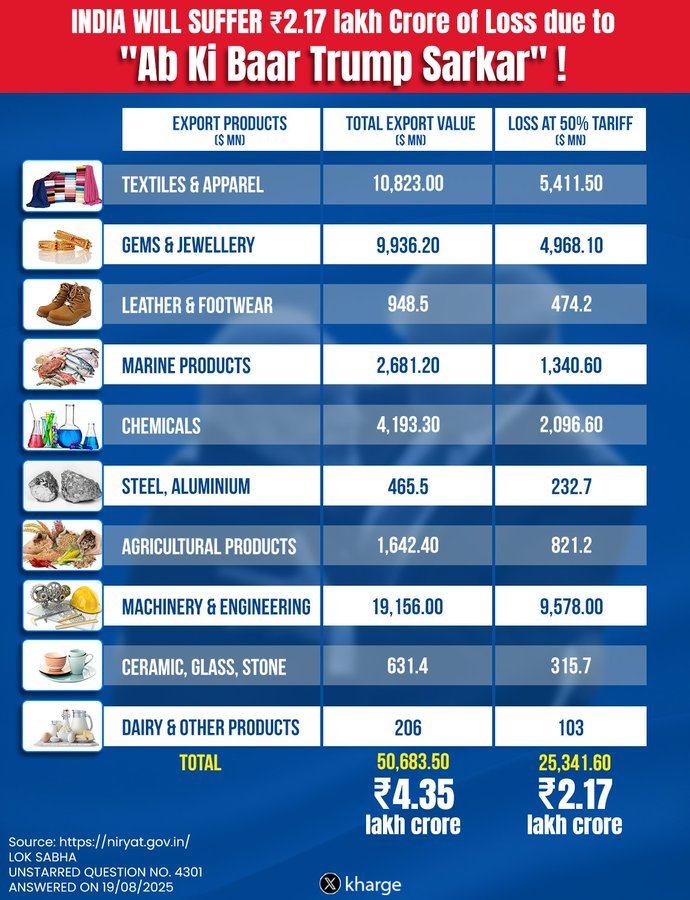
US tariffs on Indian goods
US Tariffs Deepen Strain on Indian Economy
The economic and diplomatic ties between India and the United States faced yet another setback as Washington imposed an additional 25% tariff on Indian goods, effective immediately. This decision, announced by former US President Donald Trump, has sparked a political storm in India, with opposition leaders blaming the Modi government’s foreign policy for the fallout.
Congress president Mallikarjun Kharge was quick to launch an attack on the ruling party, alleging that the steep tariff hike was the result of Prime Minister Narendra Modi’s superficial and miscalculated foreign policy. According to Kharge, this move would not only cripple India’s exports but also lead to massive job losses across multiple industries, striking directly at the livelihoods of farmers, workers, and small-scale manufacturers.
Kharge’s Attack on Modi Government
In a strongly worded post on social media platform X, Kharge mocked Modi’s earlier association with Trump during the 2019 “Howdy Modi” event in Houston, where the slogan “Abki Baar, Trump Sarkar” was prominently echoed. Referring to this, Kharge wrote:
“Narendra Modi ji, your dear friend ‘Abki Baar, Trump Sarkar’ has imposed 50% Tariffs on India starting today. We will lose an estimated Rs 2.17 lakh crore as the first jolt to this Tariff, across 10 sectors alone.”
Kharge argued that India’s leadership had failed to negotiate protective trade policies and safeguard key industries. He warned that the consequences of this tariff hike would be felt across agriculture, textiles, pharmaceuticals, automobile components, steel, and IT services.
The Cotton Farmer’s Plight
One of the most affected groups, Kharge pointed out, would be cotton farmers, particularly those in states like Maharashtra, Telangana, and Gujarat. Cotton exports have traditionally been a strong sector for India in the US market. However, with tariffs now raised by an additional 25%, demand for Indian cotton in the US is expected to shrink sharply, creating uncertainty for thousands of farmers.
Kharge accused the Modi government of turning a blind eye to this crisis, despite its earlier promises to protect farmers at any cost. “You had said you are ready to pay any ‘personal price’ to protect them,” Kharge reminded Modi, “but you have done absolutely nothing to soften the blow and protect their livelihoods.”
The opposition leader also claimed that textile workers, spinning mills, and small traders dependent on cotton exports would bear the brunt of the crisis, further aggravating rural distress in India.
India-US Trade Relations: A Volatile History
India and the United States have shared a complex trade relationship, often marked by disputes over tariffs, intellectual property rights, and market access. While the US has been one of India’s largest trading partners, frictions over protectionism and domestic interests have frequently led to tensions.
The Trump administration in particular adopted an aggressive approach to trade, pushing for “America First” policies. India, despite being seen as a strategic ally, was not spared from tariff hikes and stricter trade restrictions. In fact, in 2019, the US had already withdrawn India’s preferential trade status under the Generalized System of Preferences (GSP), which had earlier given Indian exporters duty-free access to American markets on thousands of products.
The new tariff hike, therefore, adds to an already strained relationship, pushing Indian exporters into deeper uncertainty.
Estimated Losses: Rs 2.17 Lakh Crore
Kharge estimated that the new tariff policy would cost India Rs 2.17 lakh crore in losses across 10 major sectors. While this figure has not been independently verified, experts suggest that industries such as pharmaceuticals, auto components, leather goods, agricultural products, and IT services would face severe challenges in maintaining competitiveness in the US market.
The tariff hike also threatens to worsen India’s trade deficit and disrupt the balance of payments, at a time when the global economy is still recovering from inflationary pressures and supply chain disruptions caused by the pandemic and geopolitical conflicts.
Political Reactions in India
The Congress party has seized the opportunity to highlight what it describes as the Modi government’s failure in diplomacy and foreign trade negotiations. Kharge and other opposition leaders argue that Modi’s much-publicized friendship with Trump did not translate into tangible benefits for India. Instead, they claim, India is now facing one of the harshest economic setbacks in recent years.
The ruling BJP, however, has defended its position, arguing that trade disputes are a natural part of global politics. Party leaders have suggested that the government is working on “long-term solutions” to diversify export markets and reduce dependence on the US. They also emphasize India’s strong trade relations with countries in Europe, Southeast Asia, and Africa as a way to balance the current impact.
Farmers and Industry Voices
Farmer unions have expressed deep concern over the tariff hike, warning that agriculture exports will collapse, adding to the existing struggles of the farming community. Leaders of cotton-growing associations have demanded immediate relief measures, including subsidies, loan waivers, and alternative export markets.
Meanwhile, industry bodies such as the Federation of Indian Export Organisations (FIEO) and the Confederation of Indian Industry (CII) have called for urgent government intervention to renegotiate trade terms with the US and explore opportunities in other global markets. They warn that without strong policy action, India risks losing its competitive edge.
Broader Implications for Jobs
The tariff hike’s most direct impact is expected to be on employment. Export-driven sectors such as textiles, pharmaceuticals, leather, and small-scale industries employ millions of workers across India. A decline in export orders from the US could lead to factory closures, layoffs, and wage cuts, intensifying the unemployment crisis in the country.
Analysts suggest that states heavily dependent on exports, including Tamil Nadu, Maharashtra, Gujarat, and Telangana, may see the sharpest impact. Small and medium enterprises (SMEs), already struggling with rising input costs and post-pandemic recovery, face the risk of closure.
The Road Ahead: Can India Recover?
Experts believe that India needs to diversify its trade partners and reduce over-reliance on the US market. Expanding access to Europe, the Middle East, and Southeast Asia could soften the blow, but such efforts will take time.
Negotiations with Washington remain crucial, but with the US prioritizing its domestic industries, India’s leverage may be limited. Policymakers argue that a comprehensive strategy, involving tariff negotiations, domestic subsidies, and incentives for exporters, is the need of the hour.
Additionally, analysts stress that India must focus on strengthening domestic manufacturing and improving competitiveness, so that its industries are less vulnerable to international tariff shocks in the long run.
Conclusion
The imposition of an additional 25% tariff on Indian goods by the US has triggered strong political reactions and economic concerns in India. While Congress president Mallikarjun Kharge has slammed the Modi government’s “superficial foreign policy” for failing to protect India’s interests, the ruling party insists that trade challenges are part of global dynamics.
The crisis highlights the vulnerability of India’s export-driven economy and the urgent need for long-term strategies to safeguard farmers, workers, and industries. Whether India can negotiate relief or successfully shift to alternative markets will determine the scale of the impact in the coming years.
Disclaimer
This article is a rewritten and original version based on publicly available news reports. It is intended for informational and educational purposes only. The content does not represent the official views of any political party, government, or individual. Readers are advised to cross-check facts from multiple reliable sources before forming conclusions.