
 Alina
Alina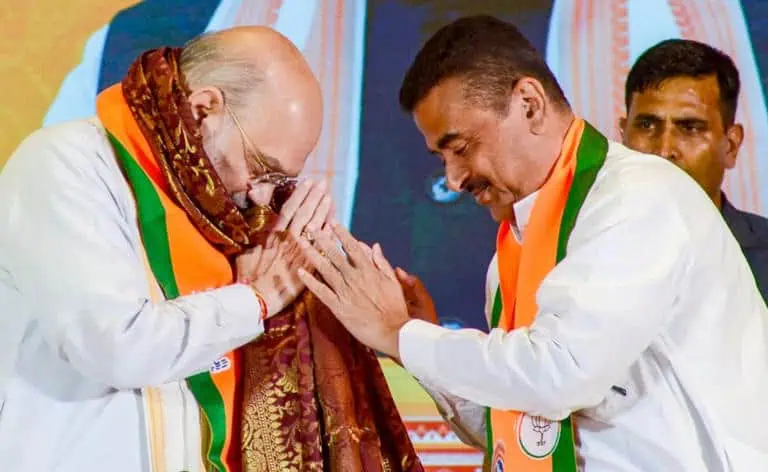
Table of Contents
ToggleBJPs Suvendu Adhikaris Dramatic Political Rise
Who Is Suvendu Adhikari?
In a historic political development, Suvendu Adhikari is set to become the first Chief Minister of West Bengal from the Bharatiya Janata Party after the party secured a landmark victory in the 2026 Assembly elections.
The BJP’s triumph has dramatically reshaped Bengal’s political landscape, ending years of dominance by All India Trinamool Congress led by Mamata Banerjee. In one of the biggest political upsets in recent state history, Banerjee lost from her stronghold Bhabanipur constituency, while Adhikari emerged as the face of the BJP’s rise in the state.
On Friday, Adhikari was officially elected as the leader of the BJP legislature party in Kolkata, paving the way for his swearing-in as Chief Minister. Senior party leaders, including Amit Shah, formally announced his selection in the presence of newly elected BJP MLAs.
According to party sources, the swearing-in ceremony is scheduled to take place at the iconic Brigade Parade Ground on May 9, marking a major turning point in Bengal’s political history.
Early Political Journey
Though today he is identified as one of the BJP’s most influential leaders in Bengal, Adhikari’s political roots lie elsewhere. His career began in the mid-1990s with the Indian National Congress.
In 1995, he became a councillor in the Kathi Municipality while serving under the Congress banner. He remained associated with the party until 1998. However, when Mamata Banerjee launched the Trinamool Congress after breaking away from Congress, Adhikari joined her new political outfit and quickly became one of its earliest and most trusted leaders.
His rise within the TMC was rapid, aided by his strong organizational skills and influence in East Midnapore district.
The Nandigram Movement and Political Rise
Adhikari’s biggest breakthrough came during the 2007 anti-land acquisition movement in Nandigram. The protests were directed against the then Left Front government’s plans to acquire agricultural land for industrial projects.
The movement transformed Bengal politics. It brought Mamata Banerjee into the center of state politics and severely weakened the Left Front’s long-standing rule.
Adhikari emerged as a powerful grassroots leader during this period. His aggressive mobilization and ability to connect with rural voters helped the TMC expand its support base.
However, the movement also attracted controversy. The state Crime Investigation Department alleged that Maoist elements had received support during the agitation, including accusations involving armed resistance against the Left Front government. These allegations became part of the larger political debate surrounding the protests.
Despite the criticism, the Nandigram movement proved politically beneficial for both Banerjee and Adhikari.
Expansion of TMC Across Bengal
Recognizing his influence, Mamata Banerjee entrusted Adhikari with key organizational responsibilities in districts such as Paschim Medinipur, Purulia, and Bankura.
Under his leadership, the TMC significantly expanded in rural Bengal. His role in consolidating support in these districts contributed heavily to the party’s eventual victory over the Left Front in 2011.
Adhikari later contested the Lok Sabha elections from the Tamluk constituency and won by a huge margin against Communist Party of India (Marxist) candidate Lakshman Seth.
His electoral success continued in the Assembly as well. He consistently won from Nandigram and gradually became one of the most influential leaders within the TMC.
Ministerial Role in Mamata Government
After the TMC formed the government, Adhikari held several important positions. In 2016, he took oath as the Transport Minister in Mamata Banerjee’s cabinet.
By then, he was widely regarded as one of the party’s strongest regional leaders with deep influence in coastal Bengal. His political stature had grown significantly, and many believed he played a crucial role in maintaining TMC’s organizational strength at the grassroots level.
However, beneath the surface, tensions within the party were beginning to emerge.
Cracks Within Trinamool Congress
By 2020, differences between Adhikari and the TMC leadership became increasingly visible. He reportedly started distancing himself from party activities, public meetings, and official programs.
Speculation over a possible split intensified after he resigned from several government positions. His resignation as MLA was formally accepted in December 2020.
Around this time, Adhikari made a statement that many interpreted as a sign of dissatisfaction within the party hierarchy. Referring to his political journey, he remarked that he had “taken the stairs step by step” rather than arriving suddenly through political privilege.
Political observers linked the growing rift to the rising influence of Abhishek Banerjee, Mamata Banerjee’s nephew, who was increasingly seen as her political successor.

Joining the BJP
In one of the most dramatic political shifts in Bengal politics, Adhikari formally joined the BJP in 2020.
His move provided a major boost to the party, which had been trying to establish a stronger foothold in the state. With his organizational experience and influence in rural districts, Adhikari quickly became one of BJP’s central figures in Bengal.
On May 10, he was announced as the leader of the BJP unit in the West Bengal Assembly, solidifying his position within the party structure.
Political Rivalry With Mamata Banerjee
The relationship between Adhikari and Mamata Banerjee transformed from close political partnership to direct rivalry.
Their rivalry gained national attention during the Nandigram Assembly battle, where Adhikari defeated Banerjee in a closely watched contest. The 2026 elections intensified that rivalry even further.
This time, the BJP not only secured power in Bengal but also managed to defeat Banerjee in her own Bhabanipur constituency, marking one of the most symbolic defeats in recent state politics.
Political analysts described it as a watershed moment, especially since it was one of the rare occasions where a sitting Chief Minister lost from their own constituency.
Controversial Statements and Communal Remarks
Following his entry into the BJP, Adhikari adopted a sharper political stance, particularly on issues related to illegal infiltration and identity politics.
He repeatedly accused the TMC government of enabling infiltration from neighboring countries and alleged that such individuals were being added to voter lists.
Over the years, several of his remarks targeting sections of the Muslim community drew criticism from opposition parties and civil rights groups.
In January 2026, Adhikari reportedly urged villagers to “separate jihadi fundamentalists from Hindus,” a statement that triggered political controversy.
After his electoral victory in Nandigram during the 2026 polls, he made another contentious remark, stating that he would work “only for Hindus” because Muslim voters had supported the TMC.
These comments sparked criticism from opposition leaders, who accused him of promoting divisive politics. BJP supporters, however, argued that he was speaking against radicalism and illegal infiltration rather than targeting communities as a whole.
Historic BJP Victory in Bengal
The BJP’s victory in the 2026 Assembly elections represents a major political transformation in Bengal. For decades, the state was dominated first by the Left Front and later by the TMC.
Under Adhikari’s leadership in the Assembly and with support from the BJP’s national leadership, the party managed to convert growing opposition sentiment into electoral success.
The election results also demonstrated the BJP’s increasing ability to challenge strong regional parties in states traditionally resistant to its influence.
What Lies Ahead
As Adhikari prepares to take oath as Chief Minister, expectations and challenges are both high.
He will now face the task of governing a politically sensitive state with deep ideological divisions. Issues such as unemployment, industrial growth, communal harmony, infrastructure, and rural development are expected to dominate his administration’s agenda.
His leadership style, political approach, and relationship with opposition parties will likely shape Bengal’s future political climate.
Conclusion
Suvendu Adhikari’s journey from a Congress councillor to a TMC strategist and finally the BJP’s first Chief Minister in Bengal reflects one of the most dramatic political transformationas in recent Indian politics.
His rise symbolizes the BJP’s breakthrough in a state where it once had minimal political presence. At the same time, his controversial remarks and aggressive political style continue to generate debate across the country.
With Bengal entering a new political era, all eyes are now on how Adhikari leads the state and whether he can fulfill the promises that helped the BJP secure its historic mandate.


