Alina
Alina
Hyderabad Leader TGPCB Accountability
Hyderabad: Cong Leader Demands TGPCB Action
Introduction: A Call for Accountability
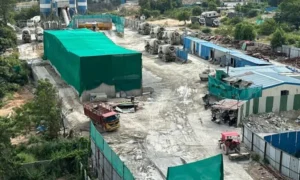
Hyderabad witnessed an impassioned appeal from social activist and Congress leader Dr. Lubna Sarwath, who questioned the Telangana Pollution Control Board (TGPCB) regarding the continued operation of a ready-mix concrete (RMC) plant. Despite prior closure orders, the Phoenix RMC plant near Mamasani Kunta in Puppalguda village, Gandipet mandal, continues its operations. Dr. Lubna’s demand was directed to the Telangana Minister of Forests and Environment, Konda Surekha, urging her to either dismiss the entire TGPCB board or enforce the closure of the Phoenix RMC plant. Her actions come on a day when Chief Minister A. Revanth Reddy highlighted the importance of preserving the environment.
Long-Standing Dispute with Phoenix Group
Dr. Lubna Sarwath has been at odds with the Phoenix Group since 2020, filing multiple complaints against the company for allegedly encroaching on water bodies, including Narsinghi Lake 2, Mekasani Kunta, Mamasani Kunta, and Bhulkapur Nala. Despite her efforts, the state government and the TGPCB have yet to take decisive action. According to Dr. Lubna, the TGPCB’s inconsistent stance, marked by a series of orders to shut down the plant, followed by revocations, has only prolonged the issue. The Hyderabad TGPCB controversy remains a point of contention for many concerned citizens, especially those living near the plant.
Closure Orders and Reversals
The timeline of events highlights the ongoing Hyderabad TGPCB controversy. The Phoenix RMC plant was granted a Consent for Establishment (CFE) by the TGPCB on September 30, 2021. Less than a year later, on September 19, 2022, the board ordered the plant’s closure, citing non-compliance with environmental regulations. However, in a twist, the TGPCB temporarily revoked this order on June 8, 2023, allowing the plant to resume operations. This decision has been a point of frustration for Dr. Lubna, who continues to question why a red-category industry like the RMC plant is allowed to function near a residential area, thereby endangering the health and safety of residents.
Residents’ Complaints and Continued Violations
The Hyderabad TGPCB controversy intensified in March and April 2024 when residents of Navnaami Residency, located directly opposite the Phoenix RMC plant, joined Dr. Lubna in lodging formal complaints about the plant’s operations. In response, the TGPCB issued a show-cause notice to the Phoenix Group on April 16, 2024. However, during a subsequent task force meeting on June 9, 2024, the board once again reiterated its decision to allow the plant’s continued operation. This decision came despite evidence presented by the complainants that the plant was still violating environmental norms, leaving many residents and activists questioning the board’s integrity.
Repeated Complaints Ignored
Undeterred, the residents and Dr. Lubna filed additional complaints on August 7 and August 14, 2024, about the Phoenix RMC plant’s ongoing violations. Despite these efforts, the plant continued to operate, with the TGPCB justifying its decision by stating that the company had complied with the board’s directions. Dr. Lubna, however, disputes this claim, emphasizing that the violations from 2021 to 2024 had placed the lives of nearby residents at risk. She argues that the TGPCB’s repeated reversals of its own orders have only deepened the Hyderabad TGPCB controversy.
Accusations Against the TGPCB
In her letter to the TGPCB, Dr. Lubna accused the board of acting in bad faith, disregarding the principles of natural justice. She stated that the TGPCB had violated the Air and Water Acts, demonstrating a lack of accountability and transparency. Her criticism of the TGPCB’s actions highlights the broader challenges in ensuring strict adherence to environmental regulations in the face of political and corporate interests. The Hyderabad TGPCB controversy has drawn attention to the struggles faced by activists in advocating for environmental protection and transparency in governance.
Congress Leader Faces Resistance from Party Members
Despite being a prominent social activist, Dr. Lubna has faced challenges from within her own party. During official Congress events, she has often found herself sidelined by party leaders, including ministers, who appear dismissive of her efforts. This disregard, coupled with the lack of action on her environmental concerns, has further fueled her frustration. The Hyderabad TGPCB controversy serves as a reminder of the difficulties faced by activists who challenge powerful interests, even within their political affiliations.
Conclusion: A Call for Justice and Action
Dr. Lubna Sarwath’s continued fight against the Phoenix RMC plant and her demand for accountability from the TGPCB highlight the pressing need for transparency in environmental governance. The Hyderabad TGPCB controversy serves as a crucial example of the ongoing struggle to balance development with environmental protection. As the deadline for further actions looms, residents and activists alike hope for a resolution that prioritizes public safety and environmental health over corporate interests. It remains to be seen whether the state government and the TGPCB will take definitive action or if the struggle for justice will continue.