Alina
Alina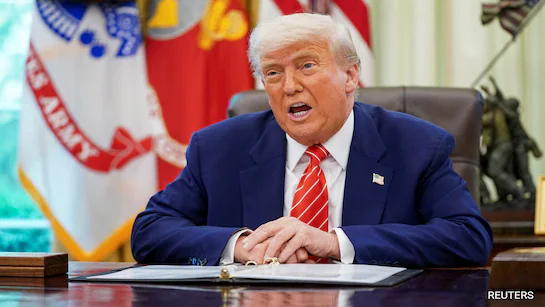
Trump on India Pakistan ceasefire
Trump Rekindles Debate With Fresh India-Pakistan Ceasefire Claim
Washington:
In a dramatic post on social media platform Truth Social, US President Donald Trump has again stirred international headlines by claiming he played a key role in brokering a ceasefire between India and Pakistan. The statement, which aligns with Trump’s broader narrative of being a global peace-broker, was part of a broader online tirade targeting American radio host and political commentator Charlamagne Tha God.
Trump’s message, published on Sunday, was blunt and direct. “Like just ending 5 Wars, including a 31-year bloodbath between the Republic of the Congo and Rwanda, where Seven Million people have died, and there was no end in sight. He didn’t know that, or India and Pakistan or wiping out Iran’s nuclear capabilities, or closing the horrendous open Border, or creating the greatest economy,” Trump wrote.
White House Backs Trump’s Peace Narrative
Just days before Trump’s post, White House Press Secretary Karoline Leavitt echoed similar sentiments, asserting that Trump had brought an end to multiple global conflicts. Leavitt even suggested that the President deserved the Nobel Peace Prize for his efforts.
Speaking during a press conference, Leavitt remarked, “The President has now ended conflicts between Thailand and Cambodia, Israel and Iran, Rwanda and the Democratic Republic of the Congo, India and Pakistan, Serbia and Kosovo, and Egypt and Ethiopia. This means President Trump has brokered, on average, about one peace deal or ceasefire per month during his six months in office.”
This bold assertion has fueled debate across diplomatic circles, particularly in South Asia, where the long-standing India-Pakistan tensions are historically sensitive and tightly managed.
India Responds: No Mediation Accepted
In response to Trump’s statement and Leavitt’s remarks, Indian authorities have reiterated their long-standing policy on bilateral issues—categorically rejecting third-party intervention. During a recent debate in the Rajya Sabha on Operation Sindoor, India’s External Affairs Minister S. Jaishankar made it clear that no conversation occurred between Prime Minister Narendra Modi and President Trump during the period in question.
“There were no phone calls between Prime Minister Modi and President Trump from April 22 to June 16,” Jaishankar stated. “India has consistently communicated that it does not accept external mediation on matters related to Pakistan.”
He emphasized that India’s stance remains rooted in direct bilateral discussions and formal diplomatic channels such as communication through the Directors General of Military Operations (DGMOs).
Operation Sindoor: India’s Strategic Response
Operation Sindoor, which became the backdrop of Trump’s renewed ceasefire claims, was a significant military development triggered by a cross-border escalation. During the Rajya Sabha debate, Jaishankar elaborated on India’s strategy and diplomatic outreach.
“When Operation Sindoor was initiated, several countries reached out to understand the situation,” he said. “We conveyed a consistent message—we were not open to any external mediation. Any issue between India and Pakistan would be settled bilaterally. We were responding to an attack, and that response would continue unless Pakistan formally requested a cessation of hostilities through the appropriate military channel.”
The statement aligns with India’s historical position dating back to the 1972 Shimla Agreement, which emphasizes bilateralism in resolving Indo-Pak issues.
Trump’s History of Similar Claims
This is not the first time Donald Trump has claimed to have intervened in India-Pakistan tensions. Back in July 2019, he had publicly stated that Prime Minister Modi had asked him to mediate the Kashmir issue—an assertion that New Delhi swiftly denied.
India’s Ministry of External Affairs then clarified that no such request had been made, and reiterated that Kashmir remains a bilateral issue between India and Pakistan.
Nevertheless, Trump’s assertions have repeatedly found traction among his supporters, especially those who view his presidency through the lens of strongman diplomacy and unconventional negotiation.
Diplomatic Sensitivities and Global Ramifications
India and Pakistan, both nuclear-armed nations, have engaged in multiple wars and skirmishes since their independence in 1947. The prospect of third-party mediation, especially by a world superpower like the US, has always been a matter of diplomatic sensitivity.
Trump’s repeated claims could have broader implications. On the international stage, they may alter perceptions about how conflicts are managed. Domestically in India, such claims are often viewed with suspicion and sometimes even as attempts to interfere in regional matters.
While some analysts argue that Trump’s messaging is aimed more at domestic audiences ahead of the upcoming US elections, others suggest it may influence how emerging global conflicts are approached in terms of negotiation and intervention.
White House: Nobel Peace Prize Justified
Leavitt’s reference to a Nobel Peace Prize has raised eyebrows globally. She argued that Trump has resolved more conflicts than any other recent US president within a similar timeframe.
“It is well past time that President Trump was awarded the Nobel Peace Prize,” Leavitt said at the press briefing.
While Trump has previously expressed interest in receiving the award, especially after his administration’s involvement in Middle East peace negotiations, the inclusion of India and Pakistan in the list of peace initiatives remains controversial.
Pakistan’s Position Remains Unclear
While India has issued a formal denial of any third-party mediation, Pakistan’s response to Trump’s recent comments has been more muted. In previous instances, Pakistan has welcomed foreign intervention on Kashmir, hoping to draw international attention to the issue.
However, in this instance, Islamabad has yet to issue a formal comment on Trump’s recent social media post or the White House briefing.
This silence could either signal tacit approval or a strategic decision to avoid confrontation on an already sensitive issue. Analysts note that any official acknowledgment from Pakistan could complicate diplomatic efforts and affect its relations with other global partners.
Expert Opinions: Political Rhetoric or Reality?
Political experts and international affairs analysts are divided over Trump’s statements. Some view them as typical Trump-style hyperbole, aimed at bolstering his peace-broker image among conservative voters.
Others, however, suggest there may be elements of behind-the-scenes diplomatic pressure or informal dialogues that never made it into public records.
Dr. Meera Shah, a former diplomat and professor of international relations, commented, “Trump thrives on projecting strength through deal-making. Whether or not those deals exist in formal documentation is often secondary to his messaging. However, when it comes to India and Pakistan, sensitivity is key. These aren’t regions you can casually claim to have fixed.”
Looking Ahead: The Road to 2024
Trump’s resurgence on Truth Social and growing activity in the political space comes at a time when the US gears up for the 2024 Presidential elections. His campaign is likely to center on themes of national security, global peace efforts, and strong economic revival—areas where he believes he has an edge.
Statements like the recent India-Pakistan ceasefire claim serve dual purposes. They not only bolster his image domestically but also reinforce his branding as a global negotiator.
However, given India’s categorical rejection of any such mediation, the truth behind these claims may continue to be debated, analyzed, and politicized—both in South Asia and beyond.
Disclaimer:
This article is for informational purposes only and is based on public statements, official briefings, and publicly available political commentary. The views and claims made by political leaders are reported without endorsement. Readers are encouraged to verify details through official diplomatic sources or credible news agencies.