Alina
Alina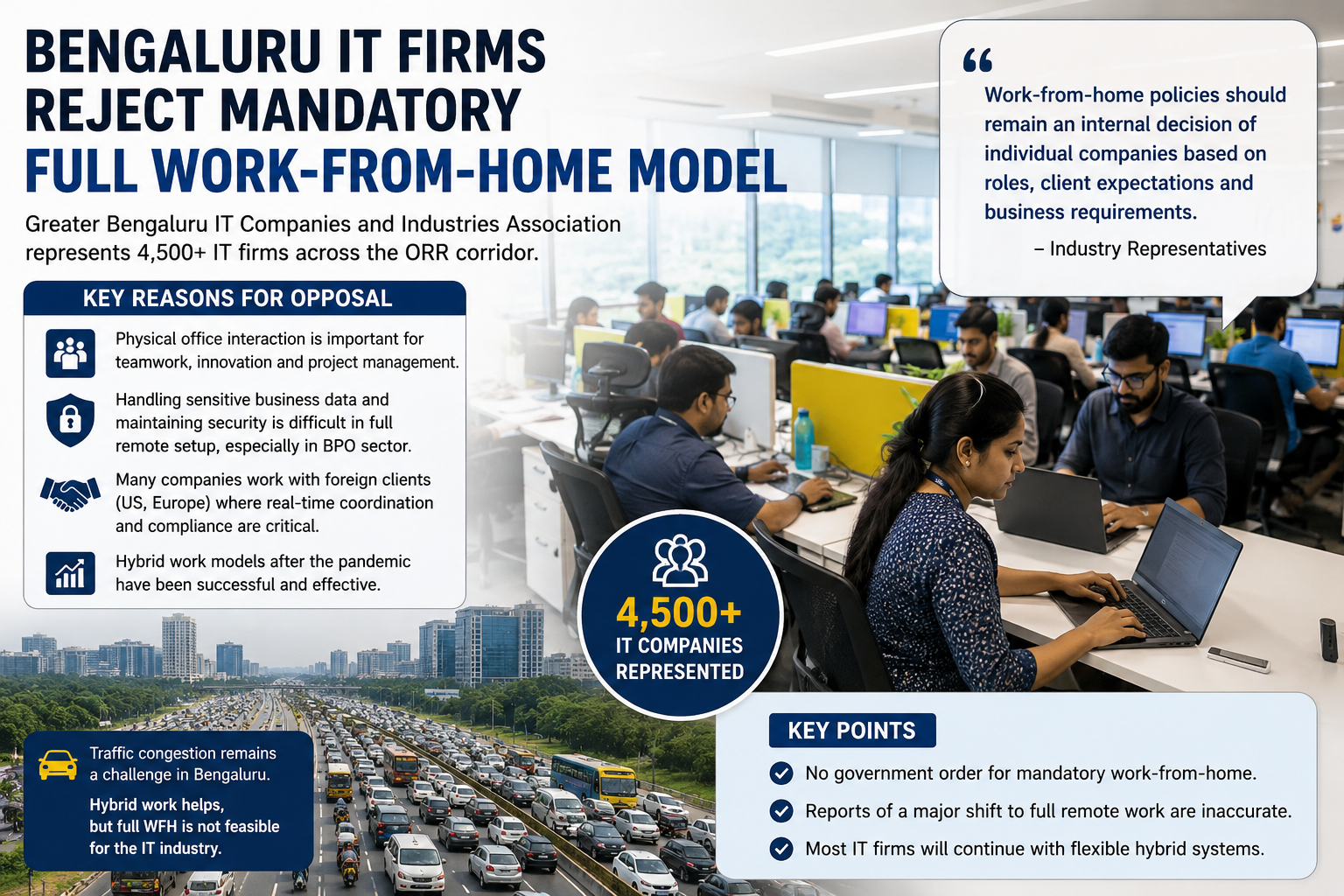
Table of Contents
ToggleBengaluru Work From Home
Bengaluru IT Firms Reject Mandatory Full Work-From-Home Model
The debate over work-from-home policies in Bengaluru’s IT sector has intensified after the Greater Bengaluru IT Companies and Industries Association strongly opposed demands for a mandatory large-scale remote working system.
Representing more than 4,500 IT companies located along Bengaluru’s Outer Ring Road (ORR) corridor, the association stated that a complete work-from-home (WFH) model is not practical for the technology industry.
Industry leaders argued that while many companies successfully follow hybrid work systems, enforcing permanent remote work across the sector could lead to operational, security, and coordination challenges.
IT Firms Support Hybrid Work, Not Full Remote
The association clarified that most Bengaluru-based technology firms are already functioning under hybrid work arrangements, where employees split time between office and remote locations.
According to industry representatives, hybrid systems introduced after the pandemic have worked effectively by providing employees with flexibility while maintaining workplace collaboration.
However, they believe a mandatory full work-from-home structure across all companies is unrealistic due to varying business requirements.
Officials stressed that companies should be free to decide workplace models based on:
- Nature of employee roles
- Client expectations
- Operational needs
- Project requirements
- Security compliance standards
They argued that a uniform remote-work mandate would not suit the diverse needs of the IT ecosystem.
Why Bengaluru IT Companies Oppose Full WFH
One of the major reasons cited by IT firms is the need for real-time collaboration and teamwork.
Industry representatives said physical office interaction remains essential for:
Better Team Coordination
In-person communication often improves decision-making, brainstorming, and project execution.
Innovation and Productivity
Companies believe office environments help employees collaborate more effectively, particularly on large and complex projects.
Project Management
Many technology assignments require close supervision and cross-functional teamwork that can be difficult to replicate fully in remote settings.
Client Communication
Several Bengaluru firms work with international clients, especially from the United States and Europe, where quick responses and compliance standards are critical.
According to the association, global clients often expect structured office operations and secure systems for handling projects.
BPO Sector Faces Data Security Concerns
The association specifically highlighted concerns in the Business Process Outsourcing (BPO) sector, where employees regularly deal with confidential customer information.
Industry officials warned that a fully remote system may create challenges related to:
- Customer data privacy
- Cybersecurity risks
- Compliance with international standards
- Confidential business information
Because of these concerns, many BPO and IT-enabled services companies continue requiring employees to attend offices regularly.
No Government Order on Mandatory WFH
Industry representatives also clarified that no official government order has been issued requiring mandatory work-from-home implementation across Bengaluru’s IT sector.
The association dismissed reports suggesting a large-scale transition toward permanent remote work, calling such claims inaccurate.
Officials maintained that workplace decisions should remain an internal matter for companies, rather than being uniformly imposed.

Traffic Congestion Sparks Fresh Debate
The discussion around work-from-home has gained attention due to Bengaluru’s worsening traffic congestion, especially across the busy Outer Ring Road technology corridor.
Several experts and public representatives have suggested increasing work-from-home adoption as a way to:
- Reduce daily traffic jams
- Ease pressure on urban infrastructure
- Improve commuting conditions
- Lower pollution levels
With Bengaluru facing major transportation challenges, remote work is increasingly seen as a possible long-term solution for easing congestion.
However, industry leaders argue that while hybrid systems may help reduce traffic, complete remote work is not suitable for every organisation.
Hybrid Work Likely to Continue
Despite rejecting mandatory work-from-home, Bengaluru IT firms indicated they will continue supporting flexible hybrid work arrangements.
Many companies are expected to maintain a balanced approach where employees work both from offices and remotely, depending on business needs.
Industry leaders believe this model offers the best combination of:
- Employee flexibility
- Workplace collaboration
- Client satisfaction
- Data security
- Operational efficiency
Conclusion
Bengaluru’s IT industry has made it clear that while hybrid work models are here to stay, a compulsory full work-from-home system is not feasible for the sector.
Citing concerns around teamwork, innovation, client coordination, and data protection, IT companies say workplace decisions should remain flexible and company-specific rather than becoming a universal policy.
As Bengaluru continues battling traffic congestion and urban infrastructure pressure, the discussion around remote work is likely to remain a major topic for both policymakers and the tech industry.
Disclaimer: This article is based on statements made by industry representatives. Workplace policies may vary between organisations depending on operational requirements and government advisories.